

LOGAN QUALITY COMMITMENT:
Logan Graphic Products, Inc. is committed to delivering products that work and exceed our customers' expectations. If you are dissatisfied with your tool's performance, do not understand the directions, or feel that you are not getting the results you expected, DON'T GIVE UP! Contact us by email or phone, and let us help solve your problem. We are here for you, and want you to be thrilled with your Logan purchase.
800 331 6232 or 847 526 5515
|

|

Blog
 Silicone rubber sealant applied to the cratered surface of velvet covered foamboard is strong enough to hold a baseball.
A christening gown, draped and suspended against a lush background. A cherished keepsake, a hole-in-one golf ball, held in place. A commemorative spoon displayed. A necklace festooned across velvet, inside a frame, hung against the wall. A gun, baby shoes, a collection of coins. So how do they do that?
3-dimensional objects of sentimental value are often worthy of framing, and as any framer can tell you, customers bring them in more often than you think. But to frame them requires more on the part of the framer than the usual stack of mat, glass and backing.
 Round objects of value present a special challenge that can be met with silicone rubber sealant.
In most cases the presentation box must be custom made and the frame fitted to it. But more than that, proper mounting techniques must be employed to hold the items firmly against a background without altering them or destroying their value.
Two key ingredients in mounting 3-dimensional objects are invisible thread and silicone rubber sealant. Invisible thread is used to sew items onto the background in an inconspicuous manner. Any object that’s loose or flowing, such as a garment or necklace can be attached in this way.
 Some objects can be bolted to the background with plastic mounting brackets called Mighty Mounts.
The background onto which the item is sewn must be foamboard. A pilot needle can be pushed through foamboard, making sewing a breeze, but the foamboard should be covered with a fabric first to provide a plush background for the item. The fabric can be tightly stretched over the foamboard and pinned in along the edges with straight pins.
Round items can be sunk partially into foamboard by gouging out a shallow crater in the surface before covering it with fabric. Silicone rubber sealant can be used to affix the item into the crater.
Silicone rubber sealant is a great way to hold valuable items in place without damaging them. Used primarily to seal cracks around windows and doors, it’s a clear rubbery substance not unlike the substance used to hold a credit card to a sheet of paper. To remove it is a simple matter of pulling it away from the surface and rubbing a thumb across the surface until it peels away cleanly.
 Invisible thread addresses a wide range of mounting challenges when it comes to loose and flowing objects.
Irregularly shaped items that can’t be sewn or glued with silicone rubber sealant can be bolted to the surface of foamboard with plastic mounting brackets called Mighty Mounts. Some Mighty Mounts are designed for mounting specific objects, such as the Mighty Mount Gun Holder, the Mighty Mount Knife Holder, or Mighty Mount Coin Holders. A wide range of objects can mounted using the Mighty Mount All-Purpose Holders.
Mounting 3-dimensional objects for picture framing can be challenging, but when you know the secrets of object box framing, the whole enterprise gets much easier.
 Watercolor paper is usually a high quality paper with a deckled edge, which many artists want to show entirely in the framed presentation.
Watercolors present a special challenge when mounting for picture framing. Because they are original art, they are usually assumed to be worth preserving and should not be adhered with most self-adhesive mounting tapes, which are difficult to remove without tearing. What’s more, watercolor paper is usually a high quality paper with a deckled edge, which many artists want to show entirely in the framed presentation, edge-to-edge.
For these reasons, mounting techniques that require the mat to overlap the edges of the artwork, such as trapping with archival mounting strips or mounting corners, are beyond consideration. Certainly, any technique that involves coating the back of the artwork with adhesive is out. So mounting with proper mounting tapes is the only alternative.
 Gummed linen tape has a high tensile strength and is reversible.
The Proper Tape for Mounting Watercolors
For mounting watercolors an easily reversible tape is essential. Reversibility is the ability to reverse the hold of the tape on the paper, allowing it to be peeled off without tearing. Gummed tapes are best for this purpose as they can be reversed with water. Just wet the head of a Q-Tip and work it along the edge of the tape. As soon as the water comes into contact with the adhesive it releases, allowing the tape to be peeled away cleanly.
Linen tapes are preferable to paper tapes when mounting watercolors. Linen tapes have a higher tensile strength, a primary consideration when mounting heavy watercolor paper.
Bearing all this is mind, gummed linen tape is the proper mounting tape for mounting watercolors.
 The S-Hinge is a technique that conceals the tape well below the top edge of the artwork.
The Proper Technique for Mounting Watercolors
The best mounting technique is the S-Hinge, which is the only hinge mounting technique that properly conceals the tape behind and within the edges of the artwork, a necessity when the edges of the artwork are irregular or deckled. “Hinge mounting” is just picture framing parlance for mounting using tape, as opposed to trapping or coating the artwork with adhesive.
Two perform an S-Hinge start with a mat blank cut to your frame size. Using an art knife or box cutter, cut two narrow slits in the mat blank about two-thirds of the way up from the bottom edge. Feed a strip of tape about 2” long through each slit adhesive-side-up relative to the top edge of the mat blank. Adhere half the tape to the back of the mat blank in the area above the slit. Allow the other half to hang tongue-like down the front side of the mat blank. The artwork is adhered image side up to the tape that hangs down the front.
Once the artwork is mounted to the mat blank, a separate window mat can be cut with a window larger than the artwork. When the window mat is placed over the artwork, the artwork appears in its entirety (including its deckled edges) within the window of the mat. Glass is placed over the window mat. Foam board is placed behind the mat blank. The entire stack is placed in the frame and you’re done.
Mounting watercolors is challenging because, given the nature of the art, your options are limited, but if you use the correct methods and materials, mounting watercolors is not difficult.
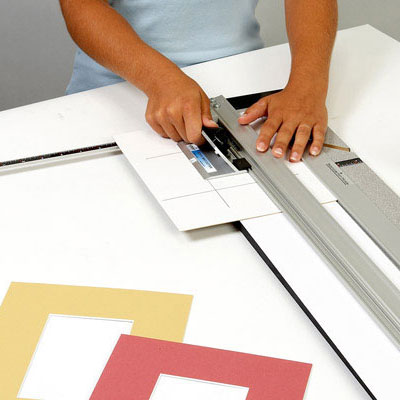
 Production stops are metal blocks or collars that are set on scales on the mat cutter's guide rail.
Hmm, “automatic production stops”, they sound like something precise and automatic. Actually, they’re neither of these. But that doesn’t mean they’re not useful. When it comes to cutting a succession of mats with repeatable quality, they’re one of the best features to have on a mat cutter. But before we examine the utility of automatic production stops, let’s get over the disappointment of what they’re not.
What They’re Not
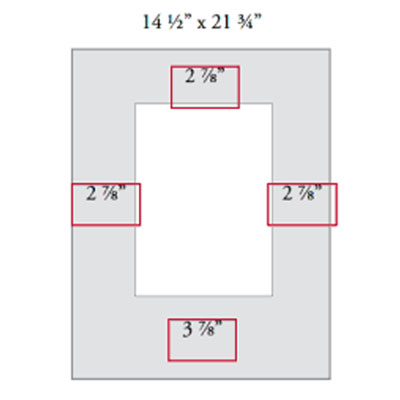
A production stop is simply a metal block or collar that looks down on the guide rail of your mat cutter to prevent your mat cutter from cutting beyond a certain point; in other words, to stop it. The place on the guide rail where you set it has a ruled scale, usually incremented in 1/16ths” or 1/32nds”. You set your stops for the borders widths of your mat. So, if your mat is to have 2-1/8”” borders, you set your stops at 2-1/8””. When you cut, the cutting head starts in contact with the top stop and ends in contact with the bottom stop.
 The cutting head stops when it contacts the stop, but that doesn't mean you'll get a perfect corner.
That’s it. That’s all they are. Nothing automatic, in spite of the name. And not necessarily precise in terms of giving you perfect corners without overcuts and undercuts, unless you know how to use them.
Be Prepared to Move
Production stops are not a set-and-forget feature; they have to be adjusted for precision. Unfortunately, here’s where the word “automatic” trips you up because it implies that there is something automatic going on, like you ought to be able to set them once and forget about it. You usually can’t.
After setting your stops don’t be surprised if you find you are still getting overcuts or undercuts. But don’t despair. By moving the stops on the scale slightly above or below the original setting, you can achieve perfect corners.
Why do you have to do this? Why can’t you just set the stops and know that your cuts will be precise?
 By moving the stops on the scales slightly above or below the original setting, you can achieve perfect corners.
Because overcuts and undercuts are directly related to the thickness of the mat board and you’re cutting a wide variety of different thicknesses of mat board, whether you realize it or not.
The difference in thickness is usually minor and often indiscernible to the eye but it’s enough to make for slight overcuts and undercuts. However, by recalibrating your stops slightly, by moving them on the scale, you can achieve perfect corners.
Learning to Love Production Stops
What’s more, as long as you don’t change to a different color or type of mat board, you can achieve repeatability; you can cut a succession of mats and know they’ll all have perfect corners. Which is why framers who do production runs – for example, 100 mats all the same size – love production stops.
When you’re rapidly cutting back and forth between stops, getting perfect corners with each cut, it really does feel sort of automatic, but this is not achieved without a little testing and recalibrating before you start.
So don’t be misled. Automatic production stops are not, strictly speaking, automatic, but with a little observation and readjustment, you can enjoy the benefits of speed and precision that they imply.
 Logan Glass Cutter At first blush it looks like the simplest thing, adding glass or Plexiglass to a picture frame. But glazing can present difficulties if not handled correctly. Having the proper tools is essential.
First, how are you going to get your glazing cut to the right size? Cutting glass and cutting Plexiglass (referred to hereafter as acrylic) appear to be pretty much the same process. However, they are different in subtle ways.
 Anti-Static Brush Cutting glass is a simple matter of scoring and snapping. Any store bought glass cutting tool will do the trick, but the Logan Model #704 Glass Cutter is specially designed to work with Logan mat cutting systems, allowing you to take advantage of the measuring systems that come with those mat cutters and avoid the tedious task of measuring the glass outside the cutter.
Cutting acrylic is another matter. A glass cutter will not cut acrylic. You will need an Acrylic/Plexi cutter like the Logan Model #709 Acrylic/Plexi Cutter. There are alternative hand-held acrylic cutters that cost far more, but this low priced tool will work just fine if you understand that you must score more than once.
 Sprayway Glass Cleaner Unlike glass cutters, acrylic cutters will not penetrate adequately with just one score. With a new #709 Acrylic/Plexi Cutter, be prepared to score on the same line 4-6 times before attempting to snap at the score. As the cutter ages, you will need to score even more times before snapping.
Most glass does not come with a protective mask over it and must be cleaned before use. Sprayway Glass Cleaner is a superior glass cleaning product used widely in the picture framing industry but these days many supermarket brands work just as well. A household paper towel works fine for wiping.
Acrylic is another matter. Acrylic has the virtue of being absolutely clean when you buy it. Acrylic typically comes with a plastic or paper mask covering both sides. Underneath the mask it’s as clean as it’s ever going to be. However, after the framed art has been hanging on the wall awhile, you may want to clean it. Glass cleaner won’t work. You’ll need an acrylic/plastic cleaner like 201 Plastic Cleaner, popular in the framing industry.
 Wyp-All Plus Towels Be careful when you go to wipe acrylic. It scratches easily. Household paper towels can cause light surface abrasions in acrylic. Instead, use a soft cotton cloth. The Wyp-All Towel by Scott, although it is a paper towel, has the texture and feel of cotton and won’t scratch acrylic.
What about dust and lint? Anybody who’s ever framed before can describe the frustration of finding tiny motes of dust and lint on the inside of the glazing after everything has been assembled. These are the result of static charge on the glazing. To reduce or eliminate static charge, you’ll need an anti-static brush or cloth. Kinetronics Anti-Static Brush is a framing industry favorite. Alternatively, Kinetronics Anti-Static Tiger Cloth can do the trick.
Finally, you will want to avoid fingerprints on the glazing as you handle it, so you will need gloves. Inexpensive white cotton gloves are available but they aren’t worth the deceptively low price because they shred easily and won’t last. Instead, invest in a pair of sturdy picture framing gloves like the Kinetronic Anti-Static Gloves, they are durable, washable and provide an extra edge against static-charge when using them.
Outfit yourself with these essential tools and you’ll find the process of glazing for picture framing much less frustrating and an altogether smoother process.
 You don't need an expensive accessory to cut a V-groove as long as you have the right kind of mat cutter and you know this method. One of the big advantages of having a professional mat cutting system is that you can cut V- Grooves on it without using a V-Groove cutting accessory.
All mat cutters above a certain price point are distinguished by the fact that the bevel cutting head cuts on the left side of the guide rail. All mat cutters below this price point cut on the right side of the guide rail. If your mat cutter cuts on the left side of the guide rail, you are in luck. To cut V-Grooves on it all you have to do is familiarize yourself with the following trim-and-tape method.
Note: The method laid out here is for the Logan Model 650 Framer’s Edge Mat Cutter but it can be applied to any mat cutter where the cutting head cuts on the left side of the guide rail.
 Cut a strip of mat board to act as a spacer. Begin by cutting a window in the mat where you want the V-Groove to appear. So if you are going to have a 1-3/4” border on your mat’s window, a good position for the V-Groove might be 1- 1/4” in from the perimeter edge, so set your mat guide for 1-1/4” and cut the window.
If you think about it, a V- Groove is really just two facing bevels, so a beveled window is half a V-groove. To get the other half you’ll need to trim a reverse bevel on the edges of the window’s drop-out piece. You can only do this on mat cutters where the cutting head cuts on the left side of the guide rail.
 Place the edge of the drop-out piece color side up against the spacer. Cut a strip of mat board to act as a spacer and place it against the mat guide. Then place the drop-out piece from the mat’s window color side up against the spacer.
Lower the guide rail of the mat cutter and hold it above the drop-out piece as you loosen the mat guide and adjust it until you have about 1/16” of the drop-out piece exposed along the left edge of the guide rail. Then lower the guide rail.
Insert the blade outside the top edge of the drop-out piece and trim down its length. You are trimming a reverse bevel on the drop-out piece. Trim all four sides. The spacer will provide uniform spacing for each trim.
 Trim down the length of the drop-out piece, trimming off a narrow strip about 1/16". Fit the drop out piece back into the window of the mat. The two facing bevels form a V-shaped groove on the face of the mat.
Turn the mat over and tape on the back using an acid-free masking tape or white artist’s tape, which is also acid-free. This tape must be acid-free as it will come into contact with the face of the artwork.
Don’t be disappointed that the V-Groove is achieved by taping it together on the back of the mat. The V-Groove in most cases is just an illusion; it only appears to be cut in the surface of the mat.
 A V-groove is really just two facing bevels. Fit the drop-out piece into the window and tape on the back and you've got a V-groove. Sure, low priced freehand V-Groove cutters can cut a V-groove in the surface of the mat, but they can’t miter the corners properly. This trim-and-tape method gives you perfect corners.
A more expensive V-Groove accessory can be adjusted to cut in the surface of the mat and give you good mitered corners, but only with a good deal of fussing with the depth adjustment.
Note that
most professional framers cut V-
Grooves by
the method
detailed here, which means
that most V-Grooves are in fact cut all the way through and taped on the back. This is because most professional framers have mat cutters that cut on the left side of the guide rail. What’s more, V-groove cutting is a craft that requires a little patience and skill, the natural domain of the professional framer.
Once you know the trim-and-tape method you can cut perfect V-grooves effortlessly and without a separate V-groove accessory. This method can be employed with the Logan Framer’s Edge 650-1 and 660-1, as well as the Logan Platinum Edge 850-1 and 860-1.
 Dry mounting is a process, common in frame shops, where the artwork is permanently affixed to foam board.
Quick. Answer this. What is conservation and archival framing?
If you’re like most people, your answer will be something along the lines of, “The assurance that the value of your artwork will be safeguarded by proper framing.”
And, like most people, you will be wrong.
To get at the true meaning of conservation and archival framing, at least as it’s performed by most frame shops, answer this question. If a framer coats the back of a piece of artwork with adhesive and sticks it permanently to foam board, can that be considered conservation and archival framing?
Most people will answer no. And most people will be wrong.
Frame shops routinely coat the back of artwork with adhesive and stick it permanently to foam board – and they some times call it “conservation and archival framing”.
 Dry mounting uses a combination of heat and pressure to adhere artwork to foam board. But is it archival?
Say What!
But how, you may ask.
For most frame shops conservation and archival framing simply means that nothing potentially acidic will come into direct contact with the artwork. It doesn’t necessarily mean that there’s nothing acidic in the frame package. Heck, in most frame jobs the most potentially acidic component is the frame itself (if it’s made of wood), but in most frame jobs the frame doesn’t come into direct contact with the artwork.
So if a frame shop is using an acid-free adhesive to permanently affix a piece of artwork to foam board, the process can still be considered archival, since nothing potentially acidic is touching the artwork.
Hold On. Let Me Get This Straight
But wait! I hear you say. Doesn’t the act of sticking artwork permanently to foam board devalue it?
 Framers like dry mounting because it produces a beautiful flat and firm mount.
Probably. But framers are usually very careful about what kind of artwork they mount in this way. They reserve this treatment for artwork that’s unlikely to increase in value, which is to say open-ended prints like posters, or digital prints that are not part of a limited edition.
When it comes to potentially valuable artwork like originals or limited editions, they mount them using archival tape that has a bond that’s easily reversible or they trap them in place with a method that puts no adhesive in contact with the artwork.
So What Exactly IS Conservation and Archival Framing
 Positionable Mounting Adhesive is another method framers use to permanently affix artwork to foam board.
Still, I hear you say. Coating anything with adhesive and sticking it permanently to foam board should not be referred to as conservation and archival framing. It’s misleading.
Well, it’s only misleading if you misunderstand what conservation and archival framing is promising you. It is not, as you may think, promising you that the value of your artwork will be preserved, although it may achieve that, depending on the methods used. But what it is promising you, regardless of the “conservation” method, is that your artwork will be presentable for many decades to come.
You see, if you use an acid free adhesive to permanently stick artwork to foam board, you have managed to keep harmful acids out of direct contact with the artwork, which means the artwork will not turn brownish-yellow as a result of acid burn, and will remain presentable for a long time to come.
Therefore, conservation and archival framing, in all cases, provides the assurance that your artwork will remain presentable for years to come, even though it may not preserve the value of it for all that time.
Presentation is different from preservation, and it’s a distinction you should keep in mind when it comes to conservation and archival framing.
 To create an S-hinge, cut slits in a mat blank and feed the tape through them.
“Hinge mounting” is a method of mounting artwork by suspending it against the mat or backing with tabs of tape.
Sometimes, however, loose media like pastels or charcoal drawings cannot tolerate being placed in direct contact with the window mat, which means you cannot tape them to the mat. You must tape them to the backing. The best way to do this is by creating an S-hinge.
The S-hinge always involves using a mat blank, which will subsequently be backed by foam board. The mat blank must have slits cut into it, so begin by cutting narrow slits in the mat blank.
To find the location for the slits, turn the mat blank face down and place the artwork image side up on the back of it, positioning it where it will be when mounted when placed on the face. Mark some guide lines to indicate this position. Then lift away the artwork.
About an inch down from where the top edge of the artwork will be located and about two inches from where the left edge will be, cut a slit in the mat board using a box cutter or utility knife. Repeat for a second slit two inches from where the right edge of the artwork will be located.
Caution: Don’t attempt to cut through the mat in one pass; instead, score the mat repeatedly, usually four to six times, to get clean edges on each slit. You will be feeding tape through these slits so make them wide enough to accommodate the tape.
Cut two tabs of mounting tape about four to six inches long and feed them through the slits. The tape should be adhesive side out as it hangs down the face of the mat. Adhere the tape to the back of the mat in the area above each slit.
On the face of the mat, pull the tape taut and tape it down with a second tab of tape to prevent curling. Position the artwork face up on the tape and press down to adhere.
The artwork is now mounted to the mat blank, which will now be backed by foam board to fill the frame and create stability.
Should you ever want to remove the artwork from the mat blank, simply reverse the hold of the adhesive where the tape is affixed to the back of the mat blank, and then, after the lifting the artwork away from the mat blank, reverse the hold of the adhesive from the back of the artwork.
The S-Hinge is the preferred method for mounting pastels and charcoal drawings but can be used on any original artwork that is to be mounted without coming into contact with the window mat.
 The Simplex Mat Cutters are the lowest priced mat cutters in the Logan line that include a bona fide squaring arm, rather that a squaring "bar" or measuring "bar".
One of the most important features on a mat cutter, and one that is often overlooked by first time buyers, is a squaring arm. The unschooled buyer is often concerned about the wrong things. Will my mat cutter warp? Unlikely. Will I have to change blades all the time? Not if you use a slip sheet. Will I have enough space for this? It’s only 40 ½” long; that’s shorter than most ironing boards.
But they rarely ask the all-important question: How will I get my full sized sheet of mat board cut to size?
Life without a Squaring Arm – arrgh!
 A proper squaring arm provides an abutment against which you can place the mat to keep it square while cutting.
If you don’t have a squaring arm, the unwelcome answer is that you’ll have to get out a ruler, straightedge and pencil and mark out the pattern for the size you want on the back of the full sized sheet; and then you’ll have to lay a long straightedge on the pencil lines and carefully score the mat several times on each line. A laborious, time-consuming process fraught with difficulty.
If you have a proper 90-degree straight cutting head, the cutting part will be easier, but you’ll still have to mark out the sheet carefully by hand, a process that is way too time consuming when you consider that you not only have to cut down mat board, you’ll also have to cut down foam board and sometimes glass.
 A proper squaring arm provides an abutment along its full length, as well as a scale, and a stop.
The process is made instantly easier with the addition of a squaring arm. Be advised, however, that a squaring “bar” is not the same thing as a squaring “arm”. A squaring bar is merely an abutment that keeps your mat board square as you cut it. It doesn’t provide you a way to measure. Some mat cutters now include a combination of a squaring bar and a measuring bar, which is a long stick with a scale on it. But the combination of the two still falls well short of the utility provided by a squaring arm.
A squaring arm is a long arm affixed at a right angle to your mat cutter’s guide rail. It will have a scale that runs its length. It does two things. It keeps your matboard square as you cut, and it provides a precise, reliable means of measuring so you can cut down full sized sheets without having to mark out lines.
Love that Squaring Arm
The utility of a squaring arm is made apparent when you are tasked with reducing glass. With the addition of a glass cutting accessory the cutting part is easy. It’s the measuring part that will have you scratching your head. How can you measure glass properly if you can’t easily mark on its surface? The answer is a squaring arm. By moving the edge of the sheet along the squaring arm to the proper point on the scale, lowering the guide rail and cutting, your glass will be reduced to size without having to make marks.
One final word of caution about buying a mat cutter without a squaring arm. If you do so, and then discover later that a squaring arm will be necessary to speed your sizing, you cannot retrofit a squaring arm to a mat cutter that didn’t come with one in the first place, which means you’ll have to buy a whole new mat cutter just to get that feature.
The lowest priced mat cutters in the Logan line that include a squaring arm are the Simplex mat cutters. Every mat cutter above the Simplex in price also includes squaring arms. Many people over the years have taken my advice to buy one of these mat cutters, rather than one of the lower priced models, just to get the squaring arm. They have never regretted it.
A squaring arm is the key to a smooth, efficient mat cutting experience. It’s not something you will want to overlook.
 Two 45-degree miter faces must come together to form a flawless seam, a perfect joint.
Building a picture frame consists of five steps: sawing, sanding, gluing, clamping and nailing. The proper sequence is evident. But the time taken at each step may not be, which is one of the reason novice framers struggle to get perfect corner joints.
Corner joints are formed when the mitered ends of two frame sections are brought together to form a 90-degree corner. The 45-degree miter faces are pressed together resulting in a thin and, one hopes, inconspicuous seam. If there is any discrepancy in the miters, however, an unsightly gap will occur.
 A hand-operated rotary sander is preferred to a power sander for making delicate adjustments to the miter.
Fast versus Slow
To get perfect corner joints each miter cut must be virtually flawless. But sawing is not something you want to toil over. In fact, the quicker your saw the better. Power miter saws are not only faster than manual saws, they are more precise as their blades cannot flex and torque like manual saw blades can. To achieve perfect joints more consistently opt for a power miter saw over a manual saw.
Even with power saws, however, you may need to sand. Sanding miters to correct discrepancies is a common part of the frame building process.
 A strap clamp is a key tool for getting good miter joints.
Here, however, speed is your enemy. Power sanders move too fast, taking off too much of the miter too quickly, causing you to overshoot your mark. When it comes to sanders you prefer a nice, slow hand-operated rotary sander like the Logan Precision Sander.
But how do you know if you miters need sanding?
The Importance of Strapping
 A misaligned V-nail is just one of the ways you can cause a gap in the seam during nailing.
The only way to know with any certainty is to assemble the frame. But once you’ve driven the nails into the frame to assemble it, you cannot get them out. So what’s called for here is a way to assemble the frame without driving nails into it. A strap clamp serves this purpose.
A strap clamp encircles the frame, drawing its mitered corners together as it is cinched around it, allowing you to inspect the joints. If there are discrepancies, the frame can be released from the clamp and sanded.
Holding it Together When Frame Making
 Gluing and nailing are of equal importance in holding the frame together. Give both their due.
Even with the miters sanded perfectly, however, gaps may appear at the joint when the frame is nailed. The act of nailing can cause gaps to appear if not performed accurately. Over-clamping, misaligning the nail or moving the frame when nailing can all result in a gap at the seam. To avoid this, glue the frame first, and then let it dry.
Picture frames are typically held together with a combination of wood glue and nails. Both contribute about equal amounts to the bond. One of the most common mistakes novice framers make is to nail the frame before the glue has been allowed to dry, on the assumption that the nail is the primary bonding agent and the glue only there to reinforce it.
 A flawless corner joint blends into the frame and is inconspicuous. It's what every framer strives for.
If the glue is not dry, the joints are vulnerable to all the inaccuracies that can occur during nailing. On the other, if the frame is glued and left to dry in a strap clamp before nailing, then the act of nailing cannot open a gap at the seam.
Sure, it takes longer to join the frame this way, but gluing and nailing is a part of the process where going slowly and taking your time can pay big dividends when it comes to getting perfect corner joints.
Quick to saw, but slow and steady when it comes to sanding, gluing and nailing. These are good things to remember when building a picture frame.
The sequence is evident, but the time taken with each step can be the difference between a poorly assembled frame and one with tight seams and perfect corner joints.
 New trends in matting design rely more on size and proportion and less on color.
Grace and subtlety are the watchwords when it comes to designs in matting today. The trend is decidedly away from the flamboyant embellishments of previous decades toward a striking yet subdued expression that finds its greatest expression in larger, thicker mats, as well as restrained enhancements such as float mounts and hover affects.
Where in the past mats were dressed up with watercolor washes and clever cutting tricks, the new paradigm is all about zeroing in on the artwork by creating broad visual fields that place the artwork distinctly at the center. White or off white mats with wide borders serve this purpose, creating a presentation that isolates a small image in a relatively large frame.
 The sequential arrangement of art in identical mats and frames creates a presentation of satisfying regularity.
The sequential arrangement of art in identical mats and frames creates a punctuated effect where the wall itself is the visual field that is broken up with a presentation of satisfying regularity.
Double matting, with its stepping down affect, which leads the viewer’s eye into the composition, is still common currency, but is increasingly supplanted by single mats that are twice as thick, providing a deep bevel effect that accomplishes the same purpose more subtly.
The use of color generally is downplayed in favor of stark white mats with bleached or cotton cores. Where color still plays a role in matting it is more restrained than in the past, offered up in narrower lines, the primary purpose of which is to break up fields rather than resonate and amplify the image.
 Off whites, wide borders and float mounted artwork all work to focus the viewer's eye on the artwork.
Bold statements are still made, of course, but utilizing size and proportion as the main tools, rather than color. Mats where the side borders are considerably wider than the top and bottom borders are one such statement . Hover affects, where the over-mat in a double mat appears to hover above the artwork, impart a subtle drama. Float mounting, where the window of the mat is larger than the artwork so that the edges of the art are visible, works a similar impression.
Trends in matting design are toward a paradoxical subtlety achieved by downplaying the overt use of color while amplifying size and proportion for a bold statement that focuses the eye on the artwork.
Image Credits:
Images of framed art courtesy of Nielsen Bainbridge Framing
Logan products are available at thousands of authorized retailers worldwide (find one here). Sorry, Logan does not sell directly to the public. For replacement parts only, contact us directly at 1-800-331-6232 (1-847-526-5515) or .
|

|